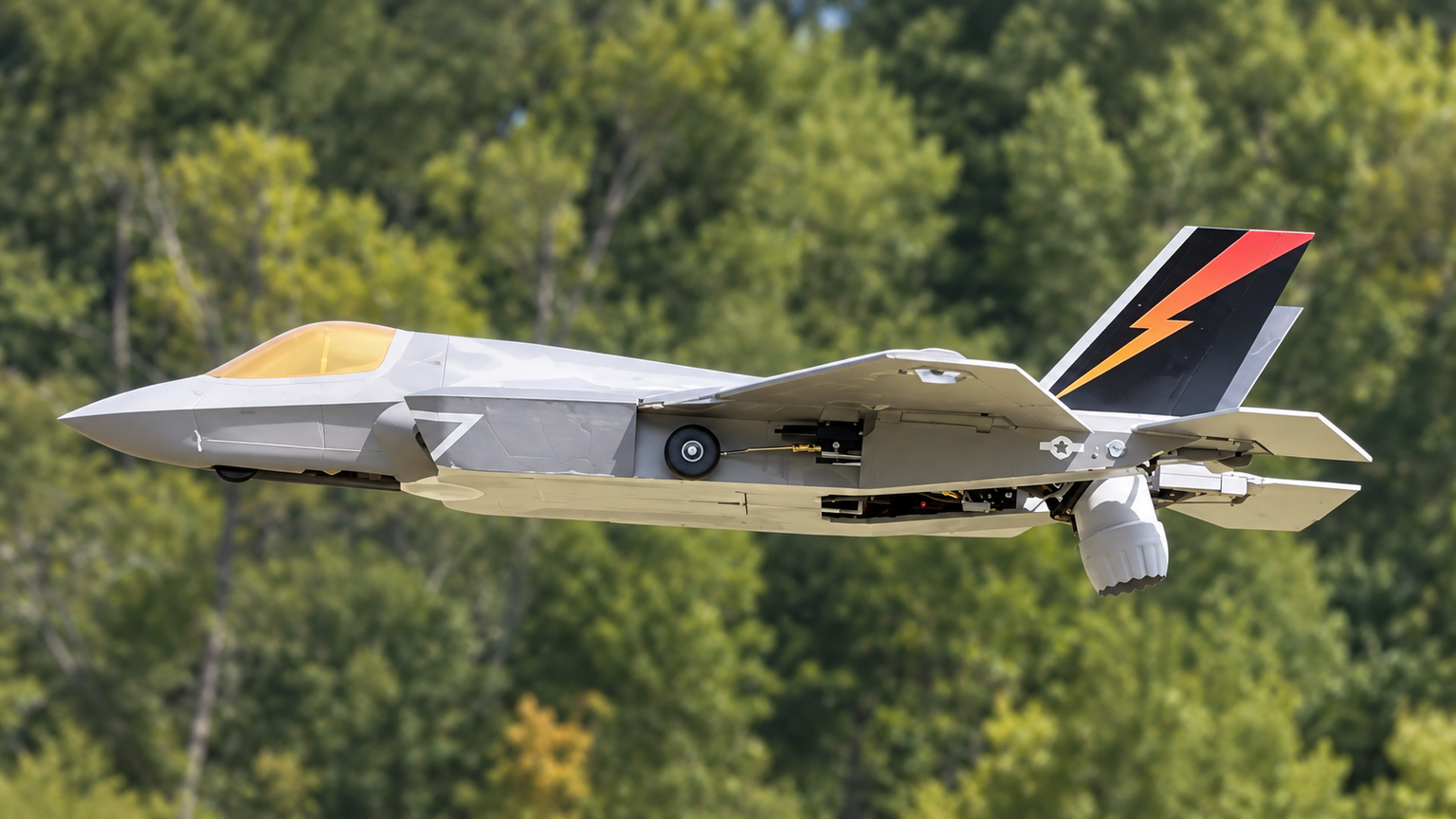
A real F-35B is already an engineering headache. Reproducing its vertical-takeoff trick in the form of a six-pound radio-controlled aircraft sounds like the sort of project that should end with an expensive crater. Eric Maglio’s 3D-printed model, however, is incredible. It flies like an airplane, hovers like a drone, and lands vertically… all without making a mess.
Maglio’s second F-35 design is built around portability. The earlier version used a 90mm fan and stayed largely assembled, while this 70mm aircraft separates into a fuselage, wings, and tail surfaces. Those pieces fit inside a professional hard case, making it really easy to bring to events around the country. The model has appeared at the Neat Fair and ArduPilot Developer Conference events in Australia and the United Kingdom.
The airframe is almost entirely 3D-printed, primarily on Bambu Lab X1-Carbon and H2S machines. Its published dimensions are serious for a model aircraft: a 30.5-inch wingspan, roughly 44.8 inches of length, 2.43 square feet of wing area, and a flying weight of about six pounds.
Making It Hover Was Very Difficult
The real F-35B incorporates a lift fan, a pivoting exhaust at the rear, and roll-control nozzles mounted on the wings. A small electric model cannot simply shrink that setup and expect the same result. To avoid the thrust loss associated with long ducting for fan air, Maglio opted for two EMAX micro quadcopter motors equipped with two-inch propellers located at the tips of the wings for roll control.
The primary source of vertical lift is the FMS 70mm ducted fan, complemented by an additional fan located in the front fuselage. Hover yaw comes from turning the rear exhaust nozzle. This nozzle functions as a fully operational three-bearing swivel module, known as a 3BSM, rather than being merely a non-functional replica.
Three HiTec CAN-bus servos move the module’s ring sections. Due to the need for the mechanism to rotate at various complex angles, Maglio developed a specialized circuit board along with software to translate tilt and rudder inputs into the necessary trigonometric movements. He says the development process involved “seven iterations of the 3BSM nozzle design, four versions of the nozzle controller, and three different actuator configurations to arrive at something that worked reliably.”
The mechanism can point beyond vertical, reaching 105 degrees. That lets the aircraft use thrust-vectoring to move forward or backward while keeping the fuselage level in GPS position-control mode. It is a clever way to avoid asking the broad wing to generate large unwanted forces every time the model changes position in a hover.
ArduPilot Turns a Science Project Into an Airplane
The flight control system utilizes ArduPilot, which is an open-source autopilot framework widely employed in unmanned aerial vehicles. Maglio adjusted its motor setup to accommodate this distinctive configuration and incorporated the necessary logic for controlling the position of the nozzles. The system offers features such as stabilization, GPS position holding, management of transitions, and the ability to return to the original launch point. “The decision to use ArduPilot was pivotal here,” Maglio says.
The model uses tail control surfaces instead of ailerons. That saves weight and avoids extra electrical or mechanical connections whenever the wings are removed for transport. The F-35’s large tail surfaces provide enough authority here.
Its power system includes an FMS 70mm 12-blade fan, an FMS Predator 80-amp ESC, a Matek flight controller, and a 6-cell, 4,000-mAh Admiral Pro battery. Eric reports about three to three and a half minutes of flight with vertical takeoff and landing, or approximately two and a half minutes of hovering alone. The model produces around 3,300 watts during vertical takeoff.
In the video, the F-35B rises steadily, converts into fast forward flight, makes a high-speed pass, then returns to a controlled hover. The gear drops, the nozzle handles the final corrections, and the aircraft settles onto the field vertically.
That is the part that makes the project so good. It is not merely a detailed F-35-shaped jet with a clever video edit. The difficult machinery is doing useful work, and the final result behaves like the aircraft it imitates. A six-pound 3D-printed fighter jet should not be this convincing. Yet there it is, hovering, transitioning, and landing as if someone forgot to tell physics that this was supposed to be a hobby project.