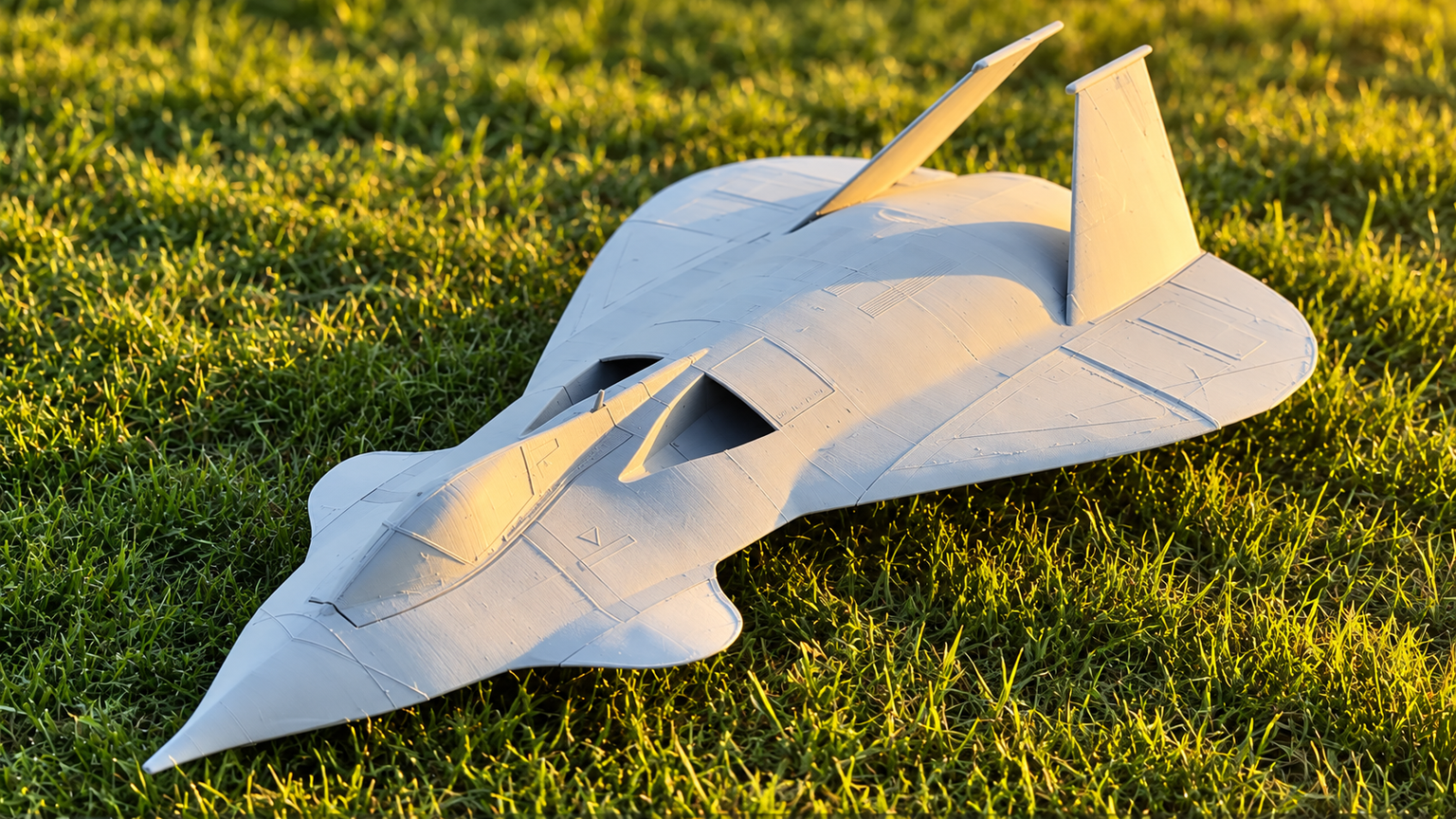
Although the F-19 was never officially developed as a U.S. fighter jet, a functional radio-controlled aircraft based on it has recently taken to the skies. In a recent Built Fast video, a man brings his gray, unfinished stealth-inspired airplane to a grassy park in the late afternoon and proves that an imaginary Cold War aircraft can still make a convincing model airplane.
The aircraft is labeled F-19 and the design draws inspiration from fictional stealth aircraft models marketed as plastic kits in the 1980s, particularly one from Revell that highly influenced its creator. In 1986, Testors introduced its own F-19 model kit, which was followed by Revell’s version in 1988. Those kits were fictional interpretations of a secret aircraft, not accurate models of the F-117A Nighthawk that was eventually revealed to the public.
The actual F-117 made its inaugural flight in 1981 and was officially in service by 1983, with deliveries commencing in 1982, according to Lockheed Martin. Unlike the smooth, canard-equipped imaginary F-19, the operational aircraft used sharply faceted surfaces and radar-absorbent coatings. Only 59 production F-117s were built.
What This Homemade Stealth Jet Is Carrying
This remote-controlled plane features a design with a blended wing-body, a sharp nose, small canards at the front, fins angled inward, and air inlets styled after NACA located on top. As spoken by the builder, the internal electric ducted fan achieves a thrust-to-weight ratio of about one-to-one, powered by a 1,500mAh LiPo battery.
To improve stability, he modified the nose section to improve lift and facilitate better control over the center of gravity. Before launch, he used a Spektrum NX8+ transmitter and reduced the roll setting to 65 percent because the short wingspan looked likely to be “twitchy.” He also admitted that his initial CG position was largely an educated guess. A portable glue gun was on stand by just in case the test went horribly wrong.
This was maybe a sensible idea. The initial hand launch was successful; however, the aircraft showed a tendency to be nose-heavy and required more roll control than he first expected. Reducing the throttle produced an immediate nose dive, yet the aircraft settled into a remarkably gentle glide and touched down on the grass with what the builder called a “floaty” landing.
He then opened the top hatch, slid the battery rearward, and restored the roll setting to 85 percent. The second launch began with a brief wobble before the airplane settled into straight, powered flight. The throttle response remained a tad bizarre: cut the motor and the nose dropped instantly, then the aircraft corrected itself and returned to a clean glide without additional pilot input. Another soft landing followed, even as daylight faded and the model became harder to spot against the darker sky in the background.

Why Does It Dive When the Fan Stops?
The builder’s center-of-gravity adjustment appeared successful because the unpowered glide was so stable. That left him searching for an explanation from something that wasn’t necessarily aerodynamic in nature.
His leading theory involves the NACA inlets and the EDF. NASA research on submerged ducts shows that these inlet designs can create vortex pairs and alter the surrounding airflow. On this model, the fan’s suction could be changing the pressure over the elevons while powered, with vortices from the airframe’s corners influencing the control surfaces. Once the fan stops, that airflow pattern may disappear abruptly, producing positive pressure over the wing and pushing the nose down.
This has turned into a bit of a mystery for the builder, but he’ll be testing off-camera to work it out.
The F-19 remains a product of Cold War secrecy and plastic-model imagination. But this little EDF jet turns the imaginary fighter into a surprisingly capable airplane. The Pentagon never built the F-19. A hobbyist did, and his version flies.