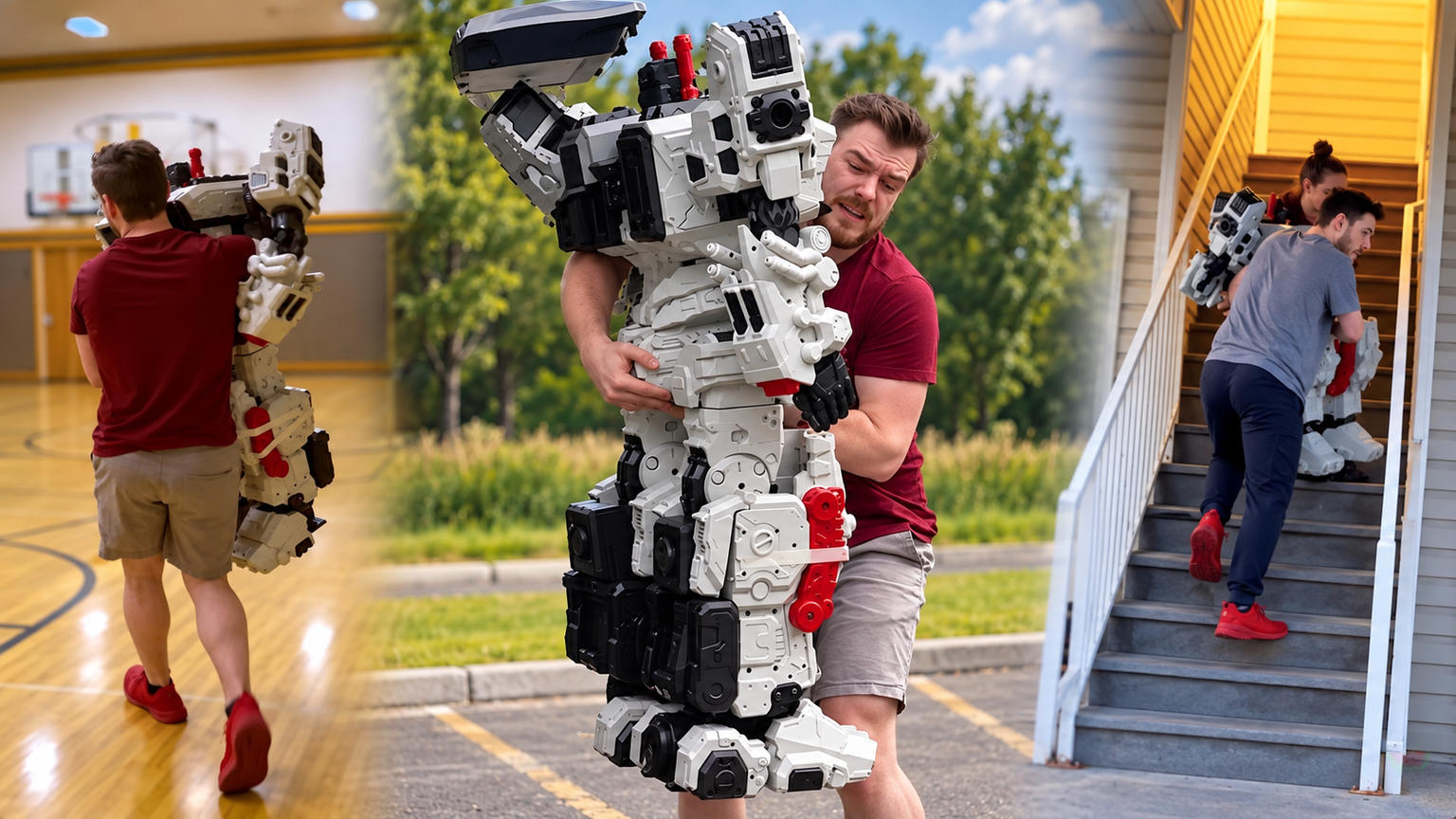
A Transformer that stands nearly four feet tall is already ridiculous. One that weighs about 90 pounds, arrives in three oversized boxes, and requires the owner to physically wrestle its limbs into position has crossed into a different category altogether. It is less “toy” and more indoor construction project with a robot face.
That is the appeal of the W-Resources M-01 Metroplex, also sold as Iron Fortress or Steel Fortress. In a roughly 20-minute video, its creator buys and tests what he calls “the biggest Transformer ever made,” then builds a miniature city around it so the enormous figure can look even more enormous.
This Is Not Merely A Large Action Figure
The scale becomes very obvious even before the robot is even assembled. White, black, and red components emerge from plastic and foam, with individual legs, arms, shoulder sections, and torso pieces already dwarfing ordinary collectibles. The figure eventually reaches about 47.24 inches to the top of its head, while its cannon-equipped height can approach 61 inches. It’s reported to weigh around 40 kilograms, or roughly 88 to 90 pounds.
Typically, the Titan-class figures from Hasbro are around 20 inches tall and weigh roughly five pounds, as noted by the designer. The 2021 HasLab Unicron from Hasbro set a higher standard, standing over 27 inches and weighing close to 16 pounds. John Warden, then a Hasbro Transformers design manager, described Unicron by saying, “The robot mode is 27 inches tall.” He also said, “We’re trying stuff with this Transformers toy that we’ve never done on any Transformers toy before.”
The M-01 makes that ambitious official release look modest. Using the listed specifications, Metroplex is about 1.75 times as tall as Unicron and roughly 5.5 times as heavy. The creator puts it at 5.6 times Unicron’s size and 18 times the mass of a Titan-class figure. Physics, as usual, has no interest in keeping the hobby affordable or manageable.
Metroplex is based on the city-forming character associated with the original Generation 1 era and the 1986 animated film. This version comes from W-Resources, a third-party company, rather than Hasbro. Its “biggest ever” status is the creator’s claim, not something confirmed by the industry. But just looking at it makes that claim pretty damn believable.
The design looks like a piece of industrial equipment dressed for a science-fiction film. The design features light gray and white armor that encloses darker mechanical elements, accented by red highlights on the feet, joints, chest, weapons, and back. Gear-driven mechanisms operate major joints such as the shoulders, elbows, hips, and knees. The figure can transform between humanoid, fortress, and battleship or mobile-carrier modes.
Assembly is an event – one that takes a little while, too. The presenter connects the legs, torso, arms, and shoulder assemblies while checking hinges, locking points, panels, and joints. Even a small adjustment means supporting a substantial section of the body. Once upright, Metroplex towers above the presenter’s waist; seated, it is roughly the size of a child. Normal Transformer figures look like accessories beside its feet.
The feature list is just as large.
The robot has articulated hands, movable arms, knees, feet, repositionable panels, 10 laser cannons, two high-energy microwave cannons, interchangeable faces, and illuminated mechanical elements. The lights in the head, chest, fingers, and weapons, all have steady and pulsing modes. The chest can also produce a rotating lighting effect, while magnetic components help control some illuminated sections.
The Miniature City Makes The Monster
The second half of the video sees the creator arrange roads, buildings, props, red structural pieces, and tiny figures around Metroplex, then lowers cameras almost to floor level. From that angle, a normal room becomes a city street and the robot becomes a skyscraper-sized machine striding through it.
Tripods, lights, smoke, and haze do a lot here. Blue and orange illumination creates a battle scene, while a darker sequence lets the red lights in Metroplex’s body glow like a movie prop. Tall gray buildings surround the robot in the final setup, although behind-the-scenes shots reveal the entire “city” occupying an ordinary room.
That is also why calling it a toy feels inadequate. A toy fits on a shelf. Metroplex appears to require floor space, structural planning, lighting design, and a recovery strategy.